
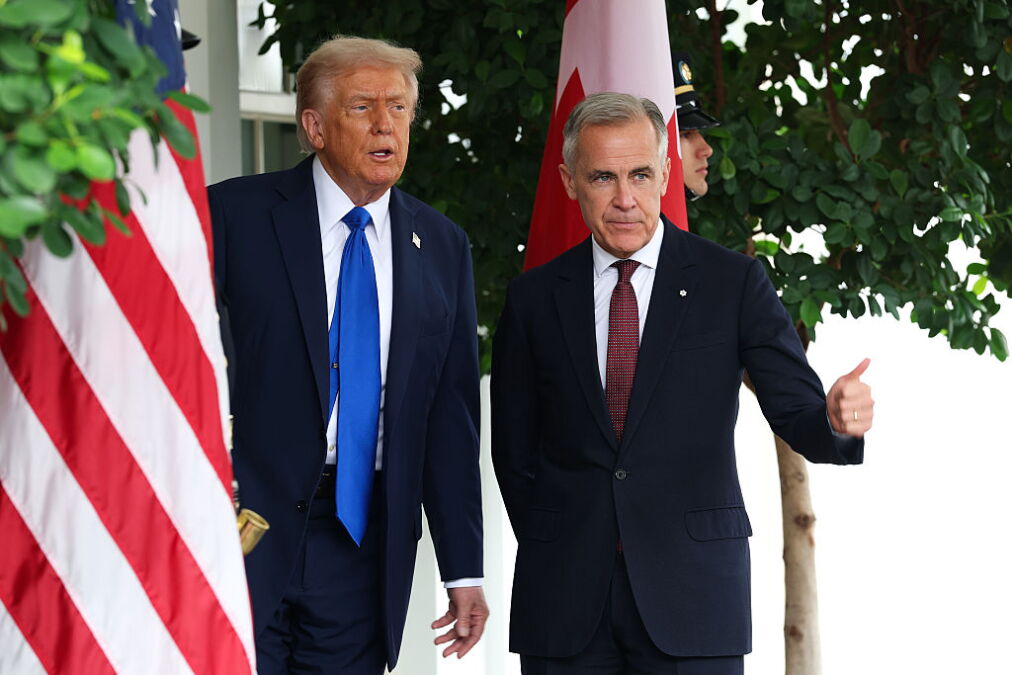
Both the U.S. and Canada have increased tariffs across the border in recent weeks,
Processing Content
Neither President Donald Trump nor Canadian Prime Minister Mark Carney appears to be ready to back down, leaving companies and their accountants to find the best way to deal with the elevated tariff costs.
“We’ve been talking to a lot of companies who import and export cross border, hearing a lot of the challenges that they’re facing right now, especially the imposition of the Section 338 tariffs that went into effect on Aug. 22,” said Dan Swartz, principal of customs and foreign trade at Ryan LLC, a global tax services and technology firm based in Plano, Texas. “It wasn’t a blanket tariff. It covers only about $20 billion of trade, roughly 500 or so tariff schedule numbers, but it is impacting a number of industries. On the Canadian side, our conversations with those companies are obviously a lot more dire, just because the duty rate is so high at 50%, and this is on top of a 10% tariff that was implemented back at the end of July under Section 301, the forced labor provision. Companies are really trying to grapple with what to do here. Do they try to wait this out?”
The tariff only covers about 5% of Canadian exports, but integrated supply chains in industries such as the automotive, steel and aluminum sectors are seeing it compound at every border crossing. While the current tariffs are already damaging businesses, the bigger fear is that this becomes a prolonged trade war between the U.S. and Canada.
Ryan is trying to advise clients on how to contain the damage.
“What we’re telling our clients is we want to determine which tariffs are going to affect your products,” said Maureen Gilfoy, director of customs duty in Canada at Ryan. “We have a tariff classification list of the products that are going to be affected. What we want to do is validate the tariff classification because if it is not correct, maybe we could take it outside of that scope and then we could remove those surtaxes. We want to look at the origin. It’s only affecting Canadian origin. Just because the goods are being exported from Canada doesn’t necessarily make it Canadian origin. We also want to look at the valuation. Are there certain costs that are included in that value that could possibly be removed because the duty is calculated on the value for duty. We want to quantify the exposure. We want to identify if there’s any relief. Can we look at duty drawbacks? Are there any other reliefs? Can we look at putting it into a foreign trade zone to minimize the duty that’s going to be due at that point, and can we extend that out? We want to determine if our sourcing in the supply chain still makes sense.”
There is still a great deal of uncertainty on both sides of the border about how the standoff will be resolved as other issues get tossed into the mix, such as Trump’s recent move to unilaterally rename Lake Ontario as Lake America.
“What is it going to take to break this logjam between the U.S. and Canada?” said Swartz. “Is it going to be political, economic or legal pressure that occurs? When you look at economic, Canada is pretty heavily dependent upon our market for selling their exported goods. We account for about 72% of all their exports. That’s actually down a bit from 2024, when it was about 76%. Canada’s been looking to make inroads in its relationship with China. That’s been diverting more of those exports over to Asia. But one in five people who are employed in Canada are dependent on jobs that are centered around exporting, although only about 12% of those goods are finished goods coming into the U.S. The rest of it really is intermediate goods that are used in U.S. manufacturing. We import a large amount of energy products as well that account for a significant percentage. But there’s obviously a lot of concern, particularly on the Canadian side. We’re about 13 times the size of the economy that Canada is, so they’re going to feel the economic pains of this much more quickly than we will.”
After the Supreme Court
“There’s obviously political pressure that’s growing here in the United States, as well as legal pressure,” said Swartz. “We’re seeing court cases being brought forward challenging the Section 338 tariffs, just as we saw with IEEPA last year, and the Section 122 tariffs that were
Huge costs
The 50% tariffs will far outweigh the earlier 25% tariffs, and it will be difficult for companies to avoid passing along at least some of the extra cost to their customers.
“It’s going to eat into any profit, and often the profit doesn’t even add up to 50%. so that’s going to be interesting to see who’s going to pick up the cost for that,” said Gilfoy. “Ultimately, it’s going to end with the consumer.”
Companies will need to try to change their sourcing to lower those costs.
“That’s absolutely going to be one of the things that everyone’s going to be looking at for sure,” said Gilfoy. “Can we source these goods elsewhere? What happens in Canada a lot too is not only do they act as the exporter of record from Canada, they also act as importer of record going into the U.S. The importer is often the purchaser, but in the case of a lot of Canadian exporters, they act as importer of record, so they basically take the brunt of the import costs. Brokerage costs are obviously minimal, but these surtaxes are going to be huge, so they’ll have to figure out how they’re going to distribute that money.”
Companies will also need to find a way to account for the extra costs.
“The bigger problem that we’re seeing is the constant change,” said Gilfoy. “When we have a purchase order, we place a purchase order, and we know what the identified costs are. We know what the duty is going to be. We have a free trade agreement amongst the countries, so most of the goods that will enter into the U.S. enter into it duty-free. The cost added on to the importation is very minimal, but then all of a sudden we have the change, and now we have a 50% tariff. That’s really hard to adapt to and to figure out where we’re going to put that. A lot of exporters in Canada are hoping that it’s not going to be a long process and that this will end. Maybe in two months’, four months’, six months’ time, we’re just going to have to absorb the cost. It depends on the relationship that they have with their customers, and if customers can source the goods elsewhere, I’m sure they will, if it means not getting a 50% additional amount onto the cost.”
Trade agreements
The situation is complicated by surtaxes and the existing U.S.-Mexico-Canada Agreement that Trump negotiated during his first administration to replace the North American Free Trade Agreement from the Clinton administration.
“We’ve got the surtax going into the U.S. for Canadian exporters, and then Canada’s putting in the retaliatory tariffs,” said Gilfoy. “Canada put on last year a 25% retaliatory tariff on a number of certain tariff classifications. Now this is going to affect the Canadian importers that are going to be importing U.S.-origin goods. That used to always come in duty-free as part of the free trade agreement. Not only are we going to see maybe 15%, but possibly 25, even 50%. We’re trying to help the Canadian exporters and navigate that going into the U S. And then we’ve got the Canadian importers with the retaliatory tariffs, and how are we going to help them?”
Ryan is advising businesses in a similar way on both sides of the border, counseling them to first look at the tariff classification to make sure it’s correct.
“What happens a lot with Canadian imports for goods that are coming in, even though they’re coming from the U.S., they don’t necessarily originate in the U.S.,” said Gilfoy. “It’s only the U.S.-origin goods that are going to be subject to the surtax if they fall into that specific tariff classification, because we have a lot of goods that come into Canada from the U.S. that originate elsewhere, in China or Taiwan or other countries.”
Many companies built their supply chains around NAFTA and the later USMCA, but those trade agreements seem to be falling by the wayside now amid the escalating trade war.
“We’ve developed this model that allows goods to travel back and forth,” said Gilfoy. “We have integrated manufacturing as well, especially in automotive and pharmaceuticals. We have goods that cross the border many times. For those industries, it’s going to be a real hit to them.”
While the USMCA is still applicable, it’s in the process of being renegotiated soon amid all the trade disputes. “The USMCA is still currently in effect right now,” said Swartz. “What it helps a Canadian company do is minimize the amount of duty that is being assessed on their goods under the most-favored nation tariffs or normal tariffs, and then also with the exemption from the Section 301 tariffs, the forced labor tariffs, if you can show that your product qualifies under USMCA, you do not get hit with that 10% forced labor tariff.”
The countries are in negotiation on changing the USMCA, he noted.
“The conversations thus far have been predominantly bilateral,” said Swartz. “The U.S. has been talking separately with Mexico and separately with Canada about a rewrite of much of the rules around USMCA. There’s a lot of attention being paid, particularly to the automotive sector, since that’s such a big part of our trade, both with Mexico and Canada. The Trump administration’s position on this is that while they are negotiating, they’re meeting with their counterparts, and they’re trying to work on some sort of deal. Trump himself has said that he didn’t care whether or not USMCA survives this, so there’s uncertainty as to what will be the future of USMCA, whether or not we’re able to cobble something together that’s trilateral, or do we look at bifurcating and have separate agreements with Mexico and Canada. Who knows how this will play out?”
Tariff stacking
Swartz advises importers to take a holistic view of the situation.
“A lot of companies get too focused on one particular tariff that’s being assessed on their product,” he said. “The reality is we’re facing a situation where there’s tariff stacking. You have the most-favored nation tariffs, potentially anti-dumping or countervailing duties, Section 232 tariffs on aluminum, steel, and other goods. You now have the 301 tariff for forced labor that’s at 10%, and Section 338, the 50% tariff. You’ve got to take a more holistic view of this, not trying to remove a particular tariff from their product. But how do we lower our overall effective duty rate as a company? And to be able to do that, there’s a variety of strategies that can be employed, including looking at prior activity, seeing if there’s any duty recovery opportunities through mechanisms like duty drawback, for example. We obviously have the duty recovery with IEEPA and these other punitive tariffs as potential recovery. The other thing to really examine is how are you classifying your imported goods under the Harmonized Tariff Schedule? The tariff classification, which is the 10-digit number, directly correlates to not only what the most-favored nation duty rate is, but whether or not your product falls under an annex that’s tied to one of these punitive tariffs, like Section 338.”
Ryan was recently working with a client reviewing some of their products coming from Canada into the United States: “They’re large capital expenditure products that go into manufacturing operations, particularly for the aerospace industry,” said Swartz. “What we found is that they’ve been misclassifying one of their key products coming into the U.S. They were looking at a 50% tariff on a product that they sell for about a million dollars, and when we looked at the tariff, we looked at previously issued rulings. We’re able to get them moved into another tariff classification that’s more descriptive for their product, likely to be more accepted by Customs as being accurate, but more importantly, removing them from the annex for Section 338 and avoiding that 50% tariff. Additionally, it removes them from the Section 301 tariff as well, so they’re looking at a significant duty reduction because of that. Going through that tariff work is really important for these importers, making sure that their products are classified.”
Customs valuation
A related issue involves customs valuation.
“In this day and age, particularly with the explosion of related-party transactions during the last 20 years, it’s not unusual for there to be multitiered transactions,” said Swartz. “Having somebody come in to reevaluate how you are selling your product into the United States, who are the various middlemen who are involved in this transaction flow, and whether or not there are costs that can be removed out of that transaction to lower your declared value, will help bring down the amount of duty that you’re paying on those imported goods.”
Similarly, Ryan looks closely at the country of origin for the imports.
“We have a very subjective country of origin statute here in the United States based around substantial transformation,” said Swartz. “We helped a client not too long ago who was bringing in freeze-dried fruit products. That was grown in regions like Morocco, Egypt and Chile, but the fruit was sent to China for freeze-drying, and the customs broker previously had been declaring it a product of China. What we were able to do is go back and look through previously issued rulings to find that just the act of freeze-drying doesn’t result in a substantial transformation, that the fruit retains its identity as being a product of Chile, Egypt or Morocco, even those being freeze-dried in China and then shipped into the U.S., significantly lowering the duty impact on that imported fruit product coming into the U.S.”
In North America, the USMCA still counts, even if it’s currently under negotiation.
“USMCA is still very important today,” said Swartz. “Companies who are often involved in generating certificates of origin don’t know how to go about qualifying goods under USMCA. It is a bit of a complex process where you have to go through a one-step-down bill of materials and evaluate against the general notes for that free trade agreement to see whether or not any of the critical components that make up that finished good come from the USMCA region: Canada, U.S. or Mexico. A lot of manufacturers particularly don’t know how to do this type of exercise. Investing some time and resources, and making sure that your goods are properly qualified under USMCA, can help significantly reduce the duty liability for the importers, both through most-favored nation duty treatment, as well as avoiding some of these punitive tariffs, like the Section 301 forced labor provision, which has a carveout for USMCA-qualified goods. Those are the kinds of things that we’re looking at for our clients, and this really centers around gathering data.”
U.S. Customs and Border Protection operates the Automated Commercial Environment system for connecting importers, exporters and trade professionals to trading data.
“Every importer today should have an ACE account,” said Swartz. “There’s no reason not to. It’s a free account from U.S. Customs, where you have access to your company’s historical import data that you’re able to download, review and analyze to see where there may be opportunities.”
Ryan, he noted, offers a complimentary trade data analysis where its professionals will examine a potential client’s data and look for opportunities for duty recovery and future duty minimization ideas, as well as potential trade compliance risk that they may face.